

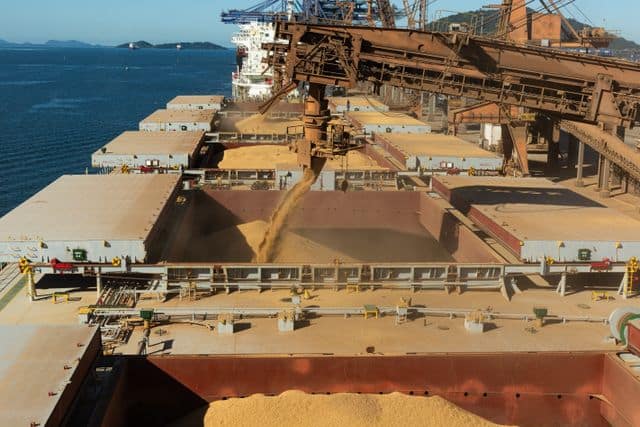
From Export Disruption to Logistics and 2027 Supply Risk
September changed the Black Sea wheat market from a port-disruption story into a broader logistics and supply-structure issue.
Russia redirected part of its lost southern export capacity through the Baltic and other alternative corridors. Ukraine continued to lean on the Danube while developing more expensive European and Baltic options.
At the same time, the disruption began moving upstream. Russian winter sowing fell to its slowest pace since 2013, producer economics weakened, and Ukraine also faced a difficult start to its winter-crop campaign.
The key question entering Q4 is therefore no longer simply how much wheat is available, but how much can be moved through competitive routes — and what today’s logistics constraints mean for the 2027 crop.
Russian Wheat Exports: Adaptation Is Faster Than Expected
Russia entered September with its southern export system under significant pressure, but the expected collapse in export flows did not materialize.
Exporters increasingly redirected wheat through Baltic terminals, while Arctic, Caspian and inland routes also gained importance. Russian September wheat exports were ultimately estimated around 2.3 MMT, higher than some early-month expectations.
The important point is not the absolute September number. It is the market’s ability to redirect cargo.
Russia is reallocating part of its export programme rather than replacing the southern system on a like-for-like basis. Alternative routes require additional rail movements, terminal capacity and different freight economics, limiting how much volume can be absorbed.
SovEcon subsequently cut its 2026/27 Russian wheat export forecast by 4.7 MMT to 36.7 MMT, reflecting the expectation that Black Sea and Azov exports will not normalize before 2027.
The export system is adapting, but at a higher structural cost.
Baltic Russian Wheat: Route Is Becoming Part of the Price
The expansion of Baltic exports has introduced a more pronounced route differential into Russian wheat pricing.
By late September, Russian 12.5% wheat from Baltic ports was assessed around $267/MT FOB, while southern Russian wheat remained around the low-$210s/MT earlier in the month.
The spread reflects logistics rather than quality: rail, inland positioning, terminal availability and alternative freight all become part of the origin economics.
This is creating a clearer distinction between available wheat and executable wheat.
For physical traders, Russian wheat can no longer be assessed purely on an origin FOB basis. The loading corridor increasingly determines the economics.
Ukraine: Alternative Routes Are Becoming More Expensive
Ukraine’s export problem has followed a similar pattern, although its alternative network is different.
The Danube remains critical, but congestion, rail constraints and higher freight have limited the corridor. Ukraine is also examining Baltic and European routes, where nominal capacity is available but logistics costs are substantially higher.
Kyiv estimates that routing grain through Baltic ports could add around $100/MT to logistics costs.
That makes the issue less about finding another port and more about whether the replacement route works commercially.
The same distinction applies as in Russia: nominal capacity does not equal executable capacity.
Ukraine’s wheat exports reached approximately 2.34 MMT by 21 September, versus 4.17 MMT at the comparable point last year.
MENA & South Asia Demand: Physical Wheat Remains Firm
September tenders continued to provide useful physical-market signals.
Algeria bought around 500–510 KMT of milling wheat at approximately $319–321/MT C&F for November shipment, around $30/MT above its August purchase.
Pakistan provided a more nuanced signal. An earlier September purchase was finalized around $348.83/MT CFR, followed later in the month by a further 180 KMT purchase at approximately $341.57/MT.
The sequence does not point to a one-way increase in physical prices. It shows a market where executable levels remain elevated but are increasingly differentiated by origin, route and timing.
Jordan also bought around 60 KMT of optional-origin hard milling wheat at approximately $332/MT C&F for first-half November shipment.
The broader signal from MENA and South Asia is that buyers continue to secure wheat, but replacement economics are increasingly determined by execution rather than futures alone.
Futures vs Physical Wheat
Wheat futures softened during September.
CBOT December settled at around 707¢/bushel on 25 September, while December Euronext milling wheat settled at €236.75/MT.
Physical wheat did not follow the same trajectory.
This divergence reflects the growing importance of logistics in the delivered market. Freight, rail availability, terminal access, insurance and route risk can maintain a physical premium even when futures are under pressure.
For Black Sea wheat, the futures market is increasingly only one component of the delivered equation.
The Supply Problem Is Moving Upstream
The most important forward signal from September came from the next crop.
By 18 September, Russia had planted around 6.1 Mha of winter grains — 14% below last year and 25% below the five-year average, the slowest pace since 2013.
The issue extends beyond weather.
Weaker domestic wheat prices, disrupted exports and higher logistics costs are putting pressure on producer margins. A prolonged period of weak economics could affect planted area and input intensity, with consequences for the 2027 crop.
This creates a second-order effect from the current export disruption.
A logistics problem in 2026 can become a production problem in 2027.
Ukraine’s 2027 Crop Also Deserves Attention
Ukraine’s winter-crop campaign also started slowly, although planting accelerated during September.
By 22 September, around 1.70 Mha of winter crops had been planted, including approximately 662 Kha of wheat and triticale.
The issue is not simply planted area. Farmers are operating under persistent logistical, financial and production constraints, while the economics of the next crop are being shaped by the same disruption affecting current exports.
Russia and Ukraine therefore face a similar forward risk from different starting points: today’s export economics are beginning to influence tomorrow’s production decisions.
The New Black Sea Wheat Equation
September produced two simultaneous developments.
The first was disruption: southern export infrastructure remained constrained and alternative corridors faced higher costs and limited capacity.
The second was adaptation: Russia redirected more wheat through alternative routes than initially expected, while Ukraine continued to expand its non-Black Sea options.
These developments are not contradictory.
The system is adapting, but adaptation does not recreate the previous cost structure.
The Black Sea wheat equation is increasingly:
origin availability → inland logistics → terminal capacity → freight and insurance → route risk → delivered economics.
That is becoming more relevant than origin FOB alone.
What Matters for October
The key October variables are straightforward.
Can Russian Baltic and other alternative routes continue to absorb additional volume without creating new rail and terminal bottlenecks?
Can southern Russian capacity recover sufficiently to reduce pressure on alternative corridors?
Can Ukraine maintain Danube flows while expanding European and Baltic routes at commercially viable costs?
And how much damage has the current export environment already done to the 2027 production base?
MENA and South Asian procurement will remain an important physical-market indicator, particularly if delivered wheat remains firm while futures stay under pressure.
September Market Outlook
September did not produce a global wheat shortage. It exposed a structural loss of low-cost Black Sea exportability.
Russia demonstrated that it can redirect meaningful volumes, but alternative routes do not replicate the scale or economics of the southern system. Ukraine faces an even tighter logistics equation, with the Danube under pressure and European alternatives carrying substantial additional cost.
The more important development is now upstream.
Slower Russian winter sowing, uneven Ukrainian planting and weaker producer economics suggest that the disruption is beginning to affect the supply base as well as the export chain.
Even if Black Sea navigation normalizes, the previous market structure will not necessarily return at the same speed.
The Q4 question is therefore not simply whether the Black Sea has enough wheat.
It is whether the region can restore large-scale southern capacity, competitive logistics and a sufficiently strong production base for 2027.
Sources & Data
This report draws on public market, trade, agricultural and logistics information, including:
- SovEcon — Russian and Black Sea grain production and export estimates
- Reuters — Black Sea export infrastructure, Russian and Ukrainian grain flows
- CME Group — CBOT wheat futures
- Euronext — European milling wheat futures
- Official Russian agricultural and government data — crop and winter sowing information
- Ukrainian agricultural and government sources — export and winter-crop data
- Official and reported MENA tender results — Algeria, Pakistan, Jordan and other importing markets
- Shipping and logistics market sources — freight, port and route information